From Passion to Paid: How to Make Money as an Independent Sports Journalist
You do not need a press pass, a journalism degree, or a commission from a major outlet to start telling sports stories. You need a niche, a voice, a publication platform, and the discipline to show up consistently. Here is how to build all four and turn them into a career.

There is a version of sports journalism that most people picture when the career comes up: the reporter on the touchline, the columnist at a national newspaper, the byline in a glossy magazine. These jobs exist and they are worth pursuing. But they are not the only version of the career anymore, and they may not even be the most interesting one.
The independent sports journalist — the writer who builds an audience directly, publishes on their own terms, and generates income from that audience without needing a traditional employer as the middleman — is one of the most compelling and genuinely viable career paths in sports media right now.
Writers like Joe Posnanski and Marc Stein have left staff roles at major organisations to publish directly to paying subscribers. Matt Brown built a six-figure newsletter business covering the economics of college sport. Countless others are doing it at every level, from hyperlocal football coverage to deep-dive analysis of sports you had never heard of until someone who cared deeply about them made you care too.
This guide is for anyone who wants to take their passion for sports journalism and build something real with it, whether the goal is to go fully independent or to use independent work as the proof that gets you hired somewhere you have always wanted to work.
Step 1: Understand What You Are Actually Building
Before you write a word, you need clarity on what an independent sports journalism career actually is, because it is different from being a staff journalist, and misunderstanding the difference trips people up early.
As an independent sports journalist, you are not just a writer. You are a publisher. You own your distribution. You build your audience. You manage your editorial schedule. You handle or delegate the business side; pricing, invoicing, sponsorships, subscriber management. That is not a reason not to do it. It is a reason to go in with your eyes open, so that none of it catches you off guard.
The good news is that the infrastructure required to do all of this has never been simpler or more accessible. You do not need a technical background, a large budget, or an existing audience to start. You need a clear sense of your niche, a commitment to consistency, and the right tools in the right order.

Step 2: Find Your Niche and Commit to It
The most important decision you will make as an independent sports journalist is not what platform to publish on or how often to post. It is what specific territory you are going to claim as your own.
The biggest mistake aspiring sports journalists make is trying to cover everything. A newsletter that covers all sports, all angles, all audiences is competing with every sports outlet on the planet and winning nothing. The publication that covers women’s cricket from a British Asian fan’s perspective, the economics of non-league football, the tactical evolution of the WNBA, or the human stories behind ultra-endurance sport — that publication has a defined audience, a clear reason for people to subscribe, and a real competitive advantage.
Your niche is the intersection of three things: what you know deeply, what you genuinely love, and where a gap exists in the current coverage landscape. The gap is the key word. You are not looking to do what the Guardian or ESPN already does. You are looking for the story, the community, the angle, the depth of coverage that nobody is currently providing at the level your audience deserves.
Specialism also builds authority faster than generalism. A writer who has published 50 focused, insightful pieces on the business of Scottish cricket is recognised as an authority in that space within months. A writer who has published 50 pieces about sport in general is just another sports writer. In a crowded market, authority is your most valuable currency and you build it through specificity.
When you find your niche, commit to it consistently. Every piece you publish, every social media post you send, every introduction you write should reinforce the same position: this is what I cover, this is why I cover it, and this is what you get from me that you cannot get anywhere else.

Step 3: Develop the Core Skills
Sports journalism is a craft, and the craft has specific components. If you are coming from a fan background rather than a journalism training background, here is what you need to develop and how to develop it on the job.
Reporting and research
The difference between sports writing and sports journalism is reporting. Journalism requires verification, sources, and original information. Before you publish claims, check them. Before you characterise a situation, speak to people with direct knowledge of it. Before you quote someone, confirm the quote.
These habits separate credible journalism from informed commentary, and credibility is the foundation everything else is built on. Develop your research muscle by going deeper than any published source. Find the primary documents (the financial filings, the official statements, the match data) and work from those rather than other journalists’ summaries.
Interviewing
The ability to draw a genuine, revealing conversation out of a subject is one of the most underrated skills in sports journalism. Good interviewers prepare obsessively. They know their subject’s history, their likely perspectives, and the specific questions that will produce insight rather than platitude. They listen actively, follow unexpected threads, and resist the urge to fill silence.
Start by interviewing people you can access: local coaches, grassroots athletes, club officials, sports business figures in your network. Record everything with permission. Transcribe selectively. Practise.
Storytelling and structure
Great sports journalism is not a recitation of facts. It is a narrative with a beginning, a tension, and a resolution, or at least a compelling new question. Study the writers you admire and dissect how they structure pieces: how they open (rarely with the obvious lede), how they control pacing, how they use specific details to create atmosphere and specificity, how they earn their conclusions.
Read widely beyond sports journalism — long-form narrative journalism of all kinds will make you a better writer faster than reading only sports.
Meeting deadlines
Self-imposed deadlines are real deadlines. If you tell your audience you publish every Tuesday, you publish every Tuesday. The journalist who publishes consistently to their own schedule is demonstrating a professional discipline that every editor, sponsor, and potential employer will notice and value.
Understanding data
Modern sports journalism increasingly requires comfort with data. Not necessarily programming-level statistical fluency, but the ability to read a data table, understand what a metric measures and what it does not, and communicate quantitative findings clearly to a non-specialist audience.
Develop this by reading data-driven sports journalism carefully, understanding the tools your sport uses, and being honest with your readers about the limitations of what numbers can and cannot tell us.
Digital fluency
You need to understand how social platforms distribute content, how SEO affects discoverability of your work, how email metrics tell you what is and is not working, and how to present your work professionally across the platforms you use. None of this requires technical expertise, it requires curiosity and the willingness to learn the tools your career depends on.

Step 4: Start Local, Start Now
One of the most common reasons aspiring sports journalists do not start is that they are waiting for the right access; the press pass for a Premier League club, the interview with the athlete they really want to write about, the commission from the publication they respect. They are waiting for permission to begin.
You do not need permission. You need to start.
The most powerful thing about independent sports journalism is that you decide what is worth covering. And there are stories worth covering everywhere, right now, within reach.
Start local. Your town or city almost certainly has sporting stories that nobody is telling, not because they are not interesting, but because the local newspaper that would have told them no longer has the resources to do it, or the national outlets that might care do not know it exists.
The non-league football club trying to stay solvent. The grassroots boxing gym producing national-level talent with no funding. The women’s basketball programme that has outperformed every comparable team in the region for three years without a single profile being written about them. The youth cricket coach who came from Sri Lanka in the 1990s and has been quietly building something extraordinary ever since.
These are not second-rate stories because they are local. They are human stories, the kind of stories that journalism exists to tell, and that are often more interesting than the 1500th profile of a Premier League manager.
Starting locally also gives you access that you simply cannot get at a higher level. A youth football club will welcome a serious journalist who wants to cover their story. A local sports administrator will return your calls and meet you for coffee. A grassroots athlete will give you time and honesty that professionals coached in media management will not.
The access you build locally — the relationships, the trust, the understanding of how sport actually operates below the glittering surface — is the foundation for everything that follows.
As you build, widen your scope. Cover your region. Find stories that have national or international resonance from a local starting point. The best journalism often starts with something specific and proximate and discovers something universal within it.
Practical access to pursue from the start:
- Local and regional sports clubs at any level — contact media officers or simply approach clubs directly explaining what you are doing
- Local council sports development teams, who often have stories about community sport they would love someone to cover
- University and college athletics — often under-reported and full of interesting stories and accessible athletes
- Amateur and masters sport — a largely uncovered world of genuine human drama
- Sports businesses, coaching academies, and sports science practitioners in your area
- Your own community — if you have a heritage, background, or connection that gives you a particular perspective on a sport or sporting community, that is a story angle almost nobody else has

Step 5: Build Your Publishing Infrastructure
This is the practical architecture of your independent journalism career. Get it right from the start and everything that follows is easier.
Your Newsletter Platform
Your newsletter is your primary owned channel — the direct relationship with your audience that nobody can take away from you. Building it is the most important structural decision you will make.
The two dominant platforms for independent journalist newsletters are Beehiiv and Substack. Both are purpose-built for this kind of publishing and both have strong track records with independent journalists.
Substack is the more established of the two and has a powerful built-in discovery ecosystem. Its Recommendations feature allows other Substack writers to surface your work to their audiences, which can generate meaningful organic subscriber growth early on. It is simple to set up, looks clean and professional immediately, and has a strong journalistic community around it.
The trade-off: Substack takes a 10% cut of all paid subscription revenue, which becomes significant at scale. A newsletter generating £100,000 annually in subscriptions gives £10,000 directly to Substack before you see it.
Beehiiv allows you to keep 100% of your subscription revenue, offers more powerful analytics, better monetisation infrastructure (including a native ad network that can generate passive income from day one on qualifying plans), and is built specifically for newsletters as businesses rather than just publications.
The free plan supports up to 2,500 subscribers — more generous than Substack for early-stage growth. The trade-off is less built-in discoverability and a slightly steeper setup curve.
I’ve used both platforms in the past and personally preferred Beehiiv. Plus, new users get a 14-day free trial and 20% off their first three months. Either way, both platforms are designed with specific features built to support independent sports journalists.

Your Email List
Your email list — separate from your newsletter platform — is the most important asset you own as an independent journalist. The newsletter platform holds your subscribers within its ecosystem. Your email list, exported and held independently, is a list you own outright: portable, exportable, and not subject to any platform’s terms of service changes.
Mailchimp has been the standard tool for this for over a decade and remains the most widely used email marketing platform in the world. It is worth noting that Mailchimp’s free plan was significantly reduced in 2026; the free contact limit has dropped to 250 and key automation features have been removed from the free tier, which makes it less useful as a completely free starting point than it used to be.
Their paid plans start from around $13 per month and are solid for managing your list, sending campaigns to your broader database, and running basic automations.
The reason to maintain an email list alongside your newsletter platform is insurance and leverage. If Substack or Beehiiv changes its terms, faces difficulties, or ceases to exist, your email list goes with you wherever you move. It is also the asset that sponsors, publishers, and potential employers find most impressive — a clean, engaged email list is demonstrable proof of a real audience relationship.
Export your subscriber list from your newsletter platform regularly and maintain it in Mailchimp or an equivalent tool. Make this a habit from the very beginning.

Your Portfolio
Your journalism portfolio is the professional shop window that editors, sponsors, and employers see when they look you up. It needs to be clean, professional, and up to date. And it needs to be somewhere purpose-built for this use, not a generic website builder trying to do 15 things at once.
Journo Portfolio is the tool of choice for independent journalists who want a proper online portfolio without the complexity of building and maintaining a full website. It’s the one I’ve been using for many years.
The platform was built specifically for journalists: you can import published articles by URL (it pulls the title, image, and description automatically), upload PDFs, embed video, and organise your work into categories and collections. Over 250,000 journalists and writers have built portfolios with it.
The free plan lets you publish a basic portfolio and is a perfectly good starting point. The Plus and Pro plans add custom domains, additional pages, automation (it checks for new articles on your feed and imports them automatically), and subscriber notification features.
For a working journalist, the Pro plan — which includes a custom domain and the full feature set — is worth paying for. It is significantly cheaper and easier to maintain than a full WordPress or Squarespace site, and it is specifically designed for the kind of work you will be showcasing.
The case for portfolio over full website, at this stage: Building a full website takes time, money, and ongoing maintenance that distracts from the actual journalism.
At the beginning of your career, a clean Journo Portfolio showing your best work, a Beehiiv or Substack newsletter delivering consistent content, and a Mailchimp list capturing your audience is a smarter, faster, and more professional combination than a half-finished website with outdated articles and a signup form that goes nowhere. Build the full website when the audience and the income justify the investment.

Step 6: Choose Your Format — and Consider Multiple
Written journalism is the foundation of most independent sports journalism careers, but the format in which you tell stories has expanded significantly. Understanding the options and how they complement each other will help you build a broader, more resilient audience.
The written newsletter
This is the core of the operation for most independent sports journalists. A regular newsletter — weekly is the standard rhythm for most successful independent publications — builds the habit for your audience, disciplines your own editorial process, and compounds over time in a way that irregular publication never does.
The newsletter can contain anything: reported features, analysis pieces, Q&As, round-ups, data explainers, opinion columns. The format is entirely yours to define. What matters is that it delivers consistent value to a defined audience on a reliable schedule.
The podcast extension
Many written sports journalists add a podcast arm to their publication, using the same content area but the audio format to reach a different kind of listener or to offer a different kind of engagement with the same audience. The podcast does not need to duplicate the newsletter. It can offer conversational analysis, interviews that do not lend themselves to written form, or a weekly digest version of your written work.
The key is integration: your podcast should drive people toward your newsletter, and your newsletter should tell people about your podcast. The two build each other.
The YouTube or video layer
If you are comfortable on camera or want to develop that comfort, a YouTube channel allows you to reach an audience that discovers content through video search in a way that newsletter platforms cannot match.
Data-driven sports journalism in particular translates well to video: walking through a tactical breakdown, explaining a visualisation, or analysing match footage are all formats that work on YouTube and bring a different audience to your written work.
The text-to-audio option
Newsletter platforms including Substack and Beehiiv allow you to publish audio versions of your written content without running a separate podcast. For journalists who want to add an audio dimension without the full commitment of a separate show, this is an easy starting point.

Step 7: Build Your Social Media Presence — Strategically
Social media is not where your audience lives. It is where you find them and give them a reason to follow you somewhere you own. The distinction matters. A large social following is not a journalism career. It is a discovery mechanism that, used correctly, builds the newsletter, podcast, or portfolio that is your actual career.
Different platforms serve different purposes, and knowing which to prioritise for what prevents you from trying to do everything badly.
X (formerly Twitter) remains the most important platform for sports journalists, full stop. The sports journalism community — writers, editors, broadcasters, PR professionals, agents, and the athletes and clubs they cover — is more concentrated on X than anywhere else.
Breaking stories circulate there first. Pitching relationships begin there. Commissioning editors still discover new voices there. Your X presence should reflect your niche with consistency: smart observations, original angles, links to your work, and genuine engagement with the conversations in your space. Build slowly and deliberately. Five hundred engaged, relevant followers in your niche are worth more than 50,000 generic sports followers.
LinkedIn is underused by sports journalists and should not be. It is where the professional reputation layer of your brand lives — where editors, HR departments, sponsors, and potential employers will look when your name comes up in a professional context.
A strong LinkedIn profile featuring your newsletter, your portfolio link, and regular posts demonstrating your expertise in your specific area of sports journalism is a professional asset that pays dividends over years. Post consistently: analysis of industry trends, reflections on your journalism practice, links to your published work with context about why you chose the story.
Instagram is best used for visual storytelling and behind-the-scenes access content rather than written journalism. If your journalism involves significant in-person reporting — attending events, being at venues, meeting people in the field — Instagram Stories and Reels give your audience a sense of the human and physical reality of your work that written content does not.
It is not the primary platform for most written sports journalists, but a maintained presence that links to your newsletter and portfolio is worth having.
TikTok and YouTube Shorts are increasingly powerful discovery channels for sports content, particularly for younger audiences. If video is already part of your format mix, short-form clips adapted for these platforms can generate discovery that translates into newsletter subscribers.
The conversion rate from short-form video to newsletter subscription is lower than from X, but the potential reach is vastly higher.
A practical approach for most starting independent sports journalists: be active and consistent on X and LinkedIn, maintain a professional presence on Instagram, and consider TikTok or YouTube Shorts if and when video is part of your format mix. Do not try to master all platforms simultaneously at the beginning. Master one or two, build genuine presence, and expand from there.

Step 8: Establish Your Voice and Approach
This is where the craft and the business converge. Your voice — the specific way you see your subject, frame your stories, and communicate with your audience — is what makes your journalism irreplaceable. It is why someone subscribes to you rather than to the infinite alternative coverage of sport that exists online.
Voice is not about affectation or artificially imposed personality. It is about clarity of perspective: what do you actually think, and how do you actually express it? The journalists who build the most loyal independent audiences are the ones whose readers trust not just their information but their judgment; whose analysis they seek out because it consistently illuminates things they had not seen or helps them think through things they had not considered.
Develop your voice by writing often and reading the feedback. What do subscribers respond to most enthusiastically? What prompts replies, shares, and the feeling that you have said something your readers were thinking but had not articulated? What makes your work different from the next piece on the same subject? Push in that direction.
Be consistent without being predictable. Your audience should know what they are getting from you — the niche, the approach, the quality level — while never quite knowing exactly what the specific argument or story will be. Consistency builds trust. Surprise within that consistency is what keeps people engaged.
And do not be afraid of having strong views. The independent journalists who build the most engaged audiences are not the ones who hedge everything and offend no one. They are the ones who have clear, defensible positions, back them up with rigorous reporting and honest reasoning, and are willing to be wrong and to say so when they are.

Step 9: Monetise — A Practical Progression by Scale
This is the section where the passion project becomes the paid career. The good news is that monetisation does not require a large audience. It requires the right audience. Here is how the income picture develops as your publication grows.
0 to 1,000 Subscribers: The Foundation Phase
At this stage, the primary goal is audience quality over revenue. The subscribers you attract in the first 0 to 1,000 are the ones who will become your most engaged readers, your most vocal advocates, and the core of your paid tier when you launch it. Do not rush to monetise before you have delivered genuine value.
That said, there are some income opportunities even at early scale. Freelance pitching to established publications using your newsletter as a portfolio is the most productive revenue activity at this stage. A sports journalist with a published, professional-looking newsletter covering a defined niche has a compelling pitch to sports editors who cover that space. You are not pitching blind, you are demonstrating existing authority and a track record.
Pitch rates vary significantly by outlet. National UK publications typically pay between £200 and £500 for a well-executed feature. US sports outlets can pay considerably more — $300 to $1,500 for strong reported pieces. Specialist sports media and trade publications can pay £150 to £400.
Start with outlets where your niche overlaps with their coverage, make your pitches specific and well-evidenced, and treat every rejection as information about how to pitch better next time.
1,000 to 5,000 Subscribers: Paid Subscriptions and First Sponsors
At 1,000 engaged subscribers with a strong open rate (above 30% is a meaningful benchmark), you have a real enough audience to launch a paid subscription tier. The standard model is a free newsletter with some content available to all subscribers and premium content — additional pieces, deeper analysis, extended interviews, a weekly briefing, a community Discord or Slack — reserved for paying members.
Pricing for paid sports journalism newsletters typically sits between £5 and £10 per month, or £40 to £80 per year with an annual discount. At 1,000 subscribers, even a 3% paid conversion rate gives you 30 paying subscribers — worth £150 to £300 per month at the lower price point. That is modest income but it is proof of concept that grows as the audience grows.
At this scale, you can also begin approaching sponsors directly. A sports newsletter with 2,000 to 5,000 subscribers and a 35%+ open rate serving a defined niche (cricket fans, sports business professionals, non-league football followers) is valuable to brands who want to reach that community.
Sponsorship rates at this scale range from £150 to £500 per newsletter issue for a primary placement, depending on niche, audience quality, and how well you can articulate the value of your audience to a potential sponsor. Sports equipment brands, specialist retailers, sports science practitioners, coaching apps, and sports betting operators are all potential sponsors depending on your niche and your editorial approach to sponsorship.
5,000 to 20,000 Subscribers: The Sustainable Business Begins
At 5,000 subscribers and above, a well-run independent sports journalism newsletter can generate meaningful monthly income from the combination of paid subscriptions, advertising/sponsorship, and freelance work. The pieces compound: a larger audience means higher sponsorship rates, which funds better journalism, which attracts more subscribers.
Paid subscription revenue at 5,000 subscribers with a 5% paid conversion rate and £7 per month average subscription value is approximately £1,750 per month — meaningful recurring income that funds the operation.
Newsletter sponsorship at this scale typically ranges from £500 to £2,000 per issue for primary placement, depending on niche. A monthly sponsorship deal at the lower end of this range adds £500 to your income. Combined with freelance commissions, a 5,000-subscriber newsletter in a defined sports niche can generate £2,500 to £5,000 per month in combined income.
This is also the scale at which broadcast opportunities start to appear. Local and regional radio stations regularly seek credible voices on specific sports topics for regular contributor slots, expert commentary, and preview/review shows. These slots are typically unpaid or nominally paid at first, but they build your public profile rapidly, generate clips that establish your broadcast credibility, and open doors to national opportunities.
If you have a defined niche and a demonstrable audience, approach local and regional radio producers with a concise, specific pitch: this is who I am, this is my specific expertise, this is the kind of insight I can offer your listeners.
20,000+ Subscribers: Full Independence and Expanded Opportunities
At 20,000 subscribers and above, the independent sports journalism model is a genuine full-time career for many practitioners. Matt Brown’s Extra Points newsletter — focused on the business of college sport — generates approximately $200,000 annually from a combination of paid subscriptions, licensing partnerships with universities, and sponsorship. The Ankler, The Big Lead, and numerous other sports and media newsletters operate at comparable scale.
Revenue streams at this level expand significantly. Sponsorship rates for a primary placement can reach £3,000 to £8,000 per issue depending on niche and audience quality. Paid subscription revenue at a 5% conversion rate on 20,000 subscribers is approximately £7,000 per month at £7 per month average.
Events — subscriber gatherings, expert roundtables, subscriber-exclusive interviews — add another revenue layer that also deepens community. Speaking engagements follow naturally from a recognised name in a specific field. Book proposals become viable. Agency and consultancy work — advising sports organisations on their own media and communications — is a natural extension of the credibility you have built.
At any scale, the freelance pathway remains open. The independent sports journalist with a newsletter, a Journo Portfolio, and a public record of strong work is the most compelling freelance applicant there is.
Major titles — the Athletic, the Guardian, the Telegraph, ESPN, Sports Illustrated — commission proven independent voices because the track record is verifiable, the niche expertise is demonstrated, and the audience relationship is real. Freelance rates at this level range from £500 to £1,500 per piece for strong features at UK national outlets, and $500 to $3,000+ for US publications.

The Long-Term Payoff: Why This Strategy Builds Careers That Last
Whether your ambition is to remain independent or to leverage independent success into a staff role, the investment in building your own journalism publication pays long-term dividends that no amount of unpaid intern work or ghost-writing can replicate.
Proof of work
Your newsletter archive, your subscriber numbers, your open rates, and your Journo Portfolio are the most compelling journalism CV that exists. They demonstrate not just that you can write, but that you can conceive, execute, sustain, and build an audience for a journalism project, which is the most important thing any sports media employer needs to know.
Audience ownership
The subscribers on your email list are yours. If you take a staff job and later return to independent work, they come with you. The audience you build now is an asset that appreciates over years and remains under your control regardless of what happens in the employment market.
Brand authority
The independent sports journalist who is recognised as the definitive voice on a specific area of sport has an authority that staff roles rarely confer. That authority opens doors — to broadcast appearances, to speaking engagements, to commissioning relationships — that a CV alone never would.
Career resilience
The sports media industry, like all media, is structurally uncertain. Staff jobs are cut, publications pivot, editorial priorities shift. The journalist who has built an independent audience and a functioning independent business is not dependent on any single employer for their livelihood. That resilience is not just financial, it changes how you operate, what stories you feel free to pursue, and what professional positions you can afford to take.
The independent sports journalism path is not the easiest path. It requires more discipline, more patience, and more business acumen than a staff job. But it is the path that, done right, builds something that genuinely belongs to you; a publication, an audience, and a career that nobody can take away.
Start small, start local, start now. The rest follows from there.

Your Action Plan: First 90 Days
To make this concrete, here is what the first 90 days of building your independent sports journalism career looks like in practice.
Days 1 to 10: Foundation
Define your niche precisely. Write it in one sentence. Set up your Beehiiv or Substack account. Create your Journo Portfolio. Sign up for Mailchimp to begin building your external email list. Set up your X and LinkedIn profiles if not already active, making your niche immediately visible in your bio.
Days 11 to 30: First content
Write and publish your first three pieces before launching publicly. These become the bedrock of your portfolio and the demonstration that you can actually produce at the level you intend. Cover something local. Interview someone accessible. Report something that nobody has reported yet.
Days 31 to 60: Launch and outreach
Send your first newsletter to anyone you know who might be interested — friends, family, former colleagues, local sports contacts. Announce your publication on X and LinkedIn. Make your first approach to local or regional sports clubs, organisations, or journalists whose beat overlaps with yours. Pitch one freelance piece to an established publication.
Days 61 to 90: Consistency and growth
Publish on your chosen schedule without fail. Engage actively on social media with the conversations in your niche. Continue pitching freelance work. Ask early subscribers to share your newsletter with one person who would enjoy it. Reach out to one podcast or platform in your niche about appearing as a guest. Build the habit that will define the years that follow.
This article contains affiliate or recommended links to tools including Journo Portfolio, Beehiiv, and Mailchimp — platforms I use and recommend based on personal experience.
Ready to take the next step?
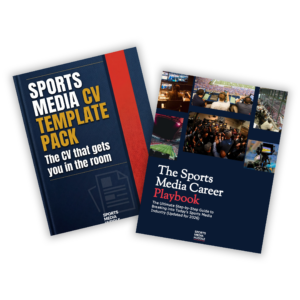
If you’re looking to turn these insights into a clear direction for your own career, The Sports Media Career Playbook breaks down the modern industry, the skills that matter most, and how to position yourself within today’s evolving media landscape.
Whether you’re just starting out or looking to refine your path, it’s designed to help you move forward with purpose and clarity.