How to Turn Your Sports Media Passion Project Into a Career
Whether you want to build an independent business or use your side project as leverage to land your dream role, the passion project is the most powerful career tool in sports media right now — if you treat it with the seriousness it deserves

There has never been a better time to build something independently in sports media. The tools are affordable, the distribution platforms are accessible, the audiences are there, and the organisations looking to hire talented people in sports media increasingly care as much about what you have built on your own as they do about your formal credentials or previous job titles.
A well-executed passion project can do two distinct but equally valuable things for your career. It can become a sustainable business in its own right, generating income through subscriptions, advertising, sponsorship, or services. Or it can serve as a living portfolio: proof of your skills, your voice, your consistency, and your specialist knowledge that makes you the obvious hire when the right opportunity arises at a media company, broadcast organisation, sports club, or agency.
Most passion projects that turn into careers do a bit of both at different stages. They build independently, attract attention, and eventually either become the career or open the door to it.
This article is a practical guide to making that journey intentional rather than accidental, across the full range of creative and technical roles that sports media encompasses. Because the path for an independent journalist launching a newsletter is very different from the one for a sports photographer building an Instagram presence, or a video editor quietly creating the reel that lands them a job at a Premier League club’s content team.
Each section here is a starting point. Every one of these categories is rich enough for its own dedicated deep dive, and we will cover each of them in standalone articles in this series. But this is the map of the territory, and it is the map you need first.
Before You Build Anything: The Foundations That Apply to Every Path
Regardless of the type of passion project you are building — a newsletter, a podcast, a photography account, a YouTube channel, a design portfolio, or anything else — there are five principles that determine whether it becomes a career asset or just a hobby that fades out after six months.
Specificity over breadth
The most common mistake people make with passion projects in sports media is trying to cover everything. A sports podcast that covers all sport, all formats, all audiences, is competing against every other sports podcast on the planet. A sports podcast that covers women’s cricket from a fan’s perspective, or the business of non-league football, or the tactical evolution of the WNBA, has a defined audience, a clear identity, and a genuine reason for people to come back. Specificity is not a limitation. It is a competitive advantage.
Consistency over volume
One newsletter per week, reliably published every Tuesday, will build an audience faster than three newsletters published randomly. One video per fortnight, delivered without fail, outperforms 10 videos in a burst followed by silence. Consistency signals professionalism. It builds trust. It tells algorithms and audiences alike that you are serious. The frequency matters far less than the reliability.
Quality over quantity
Related to the above, but distinct. The passion project that earns you a job or a loyal audience is the one where the output consistently reflects genuine care; for the craft, the subject matter, and the audience. A single brilliant piece of sports photography or a single exceptionally produced podcast episode does more for your reputation than a hundred pieces of rushed, clickbait content.
Own your platform, grow on others
Social media platforms should be used to grow audiences and drive people toward something you own — a newsletter subscriber list, a website, a podcast feed with your own RSS. The follower count on Instagram or X is an asset you are renting from a platform whose algorithm and terms of service can change overnight. The email subscriber list or the podcast audience that comes directly to you is an asset you own. Build on rented platforms, but always be pulling people toward owned ones.
Treat it like a business from day one
Even if you are not making money from it yet, the habits and structures you build in the early days of your passion project determine whether it becomes a career. File consistently. Keep records of your work. Build a simple media kit. Know your numbers; download counts, open rates, follower growth, engagement rates. These are the metrics that employers and sponsors ask about when they want to work with you. The person who knows them confidently is the person who gets taken seriously.

The Sports Journalist: Newsletters, Substacks, and Long-Form Writing
The independent journalism model has undergone a genuine revolution in the past five years. What was once dependent on the patronage of a publishing organisation (a newspaper, a magazine, a website) is now available to any writer willing to build directly with an audience.
Platforms like Substack and Beehiiv have made it straightforward to launch a newsletter with professional-quality distribution from day one. Substack alone has surpassed five million paid subscriptions globally and pays out over $600 million annually to creators. The platform takes 10% of paid subscription revenue, leaving 90% with the writer. The economics work when the audience is large enough, and the audience gets large enough when the writing is specific, consistent, and genuinely valuable.
How to start:
Choose a niche that sits at the intersection of your genuine expertise and a gap in the existing coverage landscape. The most successful independent sports journalists are not trying to compete with ESPN or the Guardian for breaking news. They are offering something those outlets cannot: depth, specificity, personality, and a consistent point of view.
Whether that is a weekly tactical breakdown of a sport you love, a newsletter about the business of a particular league, long-form profiles of athletes overlooked by mainstream media, or analysis of sports media itself, the niche is the foundation.
Publish free content first. Build the audience before you build the paywall. The conversion rate from free to paid subscribers is typically 2-5%, which means you need a meaningful free readership before a paid tier becomes financially significant. The writers who launch with a paid tier immediately often find that without an established audience, the subscriber numbers are too small to sustain motivation. Build publicly. Grow slowly. The audience comes.
The two career paths:
The newsletter can become the career directly, through paid subscriptions, sponsorships, affiliate income, and the speaking or consulting opportunities that flow from a recognised voice in a niche.
Or it can serve as the portfolio. The best writers in any niche are noticed by editors, publications, and organisations in that space. The journalist who has been writing a weekly 2,000-word tactical analysis newsletter for two years, with a meaningful open rate and a growing subscriber base, has the most compelling job application of anyone who applies to a sports media organisation covering that space.
Key platforms:
Substack, Beehiiv, Ghost. For distribution and discovery, X (formerly Twitter) remains the most important social platform for sports journalism, although engagement is becoming increasingly challenging for new accounts. LinkedIn matters for the professional reputation layer. Many newsletters now embed podcast versions of their content, adding another format and another discovery channel.
What employers look for:
Open rates (above 30% is strong), subscriber growth trends, the quality and originality of the writing itself, and evidence of a clearly defined niche. When you apply for a staff or freelance position, your newsletter is exhibit A. Make it something you would be proud to have read by the editor you are pitching to.

The Sports Podcaster: Audio, Video, and the New Media Landscape
Sports podcasting is no longer a side format. It has become, as Awful Announcing noted in their 2025 sports podcast power list, the primary delivery mechanism for sports content in many areas, replacing daytime talk shows, studio shows, and post-game analysis in the attention of younger audiences.
The market is simultaneously enormous and deeply niched. There are literally tens of thousands of sports podcasts, which means that the only sustainable path is a clear identity, unique personality, and a loyal community rather than a chase for mass reach.
How to start:
The technical barrier is low. A decent USB microphone, free or affordable recording software (Audacity for audio, OBS for video), and a podcast hosting platform (Spotify for Podcasters, Buzzsprout, Podbean) is enough to launch.
The creative barrier is higher: who are you talking to, what are you offering them that they cannot get elsewhere, and why should they choose your voice over the thousands of other options?
The most durable sports podcasts are built around a specific sport, team, league, or angle, and presented by hosts whose personality and perspective are genuinely distinctive. The tactical analysis of a specific sport. The behind-the-scenes of lower-league football from a fan who has been going for 30 years. The business of college athletics. The experience of being a Black woman in sport. These are the angles that build communities.
Video is now non-negotiable as a discovery and growth tool. YouTube has become the primary discovery platform for podcast content, and the shows that also post their recordings as video reach audiences that audio-only shows miss entirely. This does not require a broadcast studio. A decent camera, good lighting, and a clean backdrop will serve you well to begin with.
Monetisation routes:
Direct advertising and sponsorship (typically available once you reach a consistent monthly download count that makes you attractive to brands relevant to your niche), listener support through Patreon or Supercast, premium content tiers, live events, and merchandise.
The US podcast advertising market is projected to reach $5.5 billion in 2026, with monetisation no longer out of reach for smaller shows if the audience is highly targeted.
A niche sports podcast with 5,000 highly engaged listeners in a specific vertical can attract sponsorship from equipment brands, data platforms, sports betting operators, or apparel companies more effectively than a general sports show with 50,000 passive listeners.
The two career paths:
The podcast can become the business. Several independent sports podcasters have built six-figure operations through sponsorship and community.
Or it becomes the proof of concept. Broadcasters, on-air talent, producers, and analysts who have been running a podcast for two or more years have a ready-made demo of their skills, their voice, their ability to prepare and deliver content, and their knowledge of the subject. That is a more compelling audition tape than anything they could submit cold.
Key platforms:
Spotify, Apple Podcasts, YouTube. For audience growth, X and Instagram are the most effective social channels for most sports podcasts, with TikTok increasingly important for clip distribution.

The Social Media Sports Creator: TikTok, Instagram, and YouTube
This is perhaps the fastest-growing career pathway in sports media, and the one that looks most like a traditional influencer model but is, in practice, quite different when approached strategically.
The sports content creator who builds a meaningful following on TikTok, Instagram, or YouTube is demonstrating skills that are directly relevant and immediately hireable in modern sports media organisations: platform-native content creation, understanding of algorithm dynamics, ability to grow and engage an audience, and the editorial judgment to identify and package sports content that travels.
US podcast advertising revenue projections are echoed by the broader creator economy, which is valued at approximately $255 billion globally in 2026 and is projected to reach $645 billion by 2030. Brand investment is following audiences into creator-led spaces, with US creator economy ad spend forecast to hit $32.9 billion in 2026 — an 18% increase on 2025.
How to start:
Choose one platform initially and master it before expanding. TikTok and Instagram Reels reward short-form, high-energy content that hooks quickly and delivers a clear value, whether that is analysis, entertainment, reaction, education, or personality. YouTube suits longer-form content and is the most durable discovery platform for building a genuine subscriber base over time.
The same principle applies here as everywhere else: specificity is the key. A TikTok account about football tactics in general is competing with everyone. A TikTok account that explains advanced football statistics in under 60 seconds, or covers women’s football from a global perspective, or provides coach-level breakdowns of NBA plays, has a reason for people to follow and return.
Post consistently. Most successful creators in competitive niches post daily or near-daily at early stages to drive algorithm momentum, then settle into a sustainable rhythm as the audience is established. Study your analytics obsessively; watch time, retention rate, follower growth sources, and best-performing content types are the data that shapes your content strategy.
Monetisation routes:
Platform-native programs (TikTok’s Creator Rewards Program, YouTube’s Partner Programme via Google AdSense), brand partnerships and sponsored content, affiliate marketing, merchandise, and premium content. Brand deals are often the most significant revenue source and become available to creators with smaller but highly targeted audiences; a sports analytics creator with 30,000 engaged followers can command meaningful sponsorship from a data or betting platform.
The two career paths:
The social media creator can become a full-time independent business, running brand partnerships, consulting, and building a media identity as a solo operator. Or, increasingly, they become the direct hire: sports clubs, media organisations, broadcasters, and agencies are actively looking for people who can create platform-native content and understand how social media audiences work from the inside.
A TikTok creator who has grown a sports account from zero to 50,000 engaged followers is demonstrating exactly that capability. The portfolio is public, visible, and measurable.

The Sports Photographer: Instagram, Portfolio Sites, and the Path to Accreditation
Photography is one of the most visually immediate of the passion project paths. The work speaks for itself in a way that written or audio content takes longer to demonstrate. A strong sports photography Instagram account is not just an audience-building tool; it is a live, constantly updated portfolio visible to editors, clubs, agencies, and anyone else who can commission work.
The fundamental structure of a sports photography career has not changed dramatically: build a strong portfolio, develop relationships with the people who commission and publish photography, seek accreditation at events, and gradually move from local and amateur events to larger and more prestigious ones.
What has changed is the route to visibility. Instagram in particular has become the primary shop window for sports photographers at every level, and the account you build there is the first thing anyone who is considering working with you will look at.
How to start:
Photograph everything you can access. Local sports events (community athletics, non-league football, grassroots rugby, school sports) provide the practice ground where you develop the technical skills that sports photography demands: fast shutter speeds, anticipating the peak action moment, working with challenging light conditions, and understanding the sport well enough to know where the decisive moment will come from. The sports photographer who understands the game is always ahead of the one who does not.
Build your Instagram account around a consistent visual identity and a specific area of focus. All-round sports photography accounts are less distinctive than those with a clear subject; a photographer who specialises in the emotional storytelling of women’s sport, or the textures and atmosphere of non-league football, or action sequences from combat sports, builds a recognisable body of work that attracts commissioners who need exactly that.
Seek accreditation progressively. Start by contacting local and semi-professional clubs directly. Many smaller clubs have no dedicated photographer and will welcome someone offering to cover their games in exchange for accreditation and published credit. Build those relationships. Those credits and those contacts open doors to larger events and organisations.
Monetisation routes:
Freelance commissions from publications, websites, and agencies; direct contracts with sports clubs and organisations; wire service contributions (Getty Images, Reuters, AFP all use contributor networks); stock photography sales; personal print sales; commercial work for brands and sponsors.
The two career paths:
The photography business can be built as an independent freelance operation, with a diversified client base across publications, clubs, events, and brands. Or the Instagram portfolio and the track record it demonstrates can be the route to a staff or contracted role with a club, media organisation, or specialist sports photography agency. The sports photographer who has spent two years building a distinctive body of work and a following on Instagram has the most compelling application for either path.
Key platforms:
Instagram (primary), with Pinterest increasingly valuable for driving search-based discovery of photography work. A professional website hosting a curated portfolio is essential as the destination beyond social. It is where the full body of work lives and where clients can contact you directly.

The Video Editor and Producer: Building a Reel That Opens Doors
Video editing is one of the most in-demand skills in sports media and one of the clearest areas where a passion project serves directly as a portfolio. Unlike writing or photography, where the work may need contextualisation or explanation, a video reel speaks immediately and completely. Either the work is good or it is not. Either it demonstrates the specific skills the employer needs or it does not.
The passion project for a video editor or producer in sports media is built around creating the reel — the curated showcase of best work that demonstrates capability, versatility, and creative voice to anyone considering commissioning or hiring you. The reel is the career. Building it intentionally, across a range of sports content, is the whole game.
How to start:
Create content with whatever access you have. Offer to edit for local sports clubs, community sports organisations, or independent journalists and podcasters. Volunteer with college athletics programmes. Cover local events and create highlight packages.
The footage does not need to come from professional sport. The editing skill, the sense of pacing, the ability to tell a story through moving image, transfers entirely from amateur to professional contexts. What employers want to see is craft, not brand names.
Master the tools. Adobe Premiere Pro and DaVinci Resolve are the industry standards for sports video editing. After Effects for motion graphics. Understanding colour grading, audio mixing, and the specific technical requirements of different delivery formats (broadcast, social media, streaming) all contribute to your marketability. The editor who can also handle basic motion graphics and colour correction is significantly more valuable than one who can only cut.
Build a YouTube channel or Vimeo portfolio that hosts your work publicly. Include a variety of formats — highlight reels, feature packages, short-form social content, long-form documentary-style pieces if relevant. Show range. The first 30 seconds of your showreel are the most important: that is what gets watched if nothing else does. Put your best work there, without exception.
Monetisation routes:
Freelance project-based work (rates ranging from $20-50 per hour for beginners, $50-100 for experienced editors, $100+ for specialists in sports content); contracts with sports clubs and organisations for ongoing content production; working with independent content creators who need editing support; building a small agency serving sports media clients.
The two career paths:
The freelance editing business, built through client work and word of mouth, can grow into a full-time income or a specialist agency. Or the reel becomes the direct route to a staff position; every sports club with a social media team, every broadcast organisation, every sports media company has a constant need for skilled video editors, and the person with a strong public portfolio of sports-specific editing work is immediately identifiable as a qualified candidate.
Key platforms:
YouTube and Vimeo for portfolio hosting, LinkedIn for professional positioning and direct employer discovery. Platforms like Upwork and Fiverr can generate early clients while you build your reputation, but the sports-specific career is built through direct outreach to clubs, organisations, and agencies rather than generalist freelance platforms.

The Sports Graphic Designer: Social-First Portfolios and the Visual Identity Economy
Sports graphic design has become one of the most visible and immediately hireable skill sets in the industry. Every professional club, every sports media outlet, every sports event organisation needs a constant flow of social media graphics, matchday assets, broadcast overlays, sponsor integration designs, and visual identity materials. The demand is consistent and the supply of people who combine genuine design skill with a deep understanding of sports culture and aesthetics is smaller than you might expect.
The passion project for a graphic designer in sports media is the public portfolio of sports-specific work, and the most effective place to build that portfolio is where sports design is consumed and noticed: Instagram, Twitter/X, and LinkedIn.
How to start:
Create speculative work. Design social media graphics for clubs you support. Create alternative kit concepts or brand identity systems for sports organisations. Produce matchday graphics in the style of a specific league or club. Redesign the visual identity of a sporting event.
This speculative work, that demonstrates your aesthetic sensibility and technical skill without a client brief, is entirely valid as portfolio material and is widely used by designers at every level to demonstrate capability in a specific space.
Study the visual language of the specific area of sports design you want to work in. Sports club social media design has very different conventions from broadcast graphics, from apparel design, from event wayfinding. Pick your lane and go deep.
Tool fluency is essential: Adobe Illustrator, Photoshop, After Effects, and, increasingly for motion graphics, Adobe Animate or equivalent. An understanding of how designs translate across different formats and platforms (1080×1080 static for Instagram, 9:16 for Stories and Reels, broadcast-safe colour ranges for TV overlays) is the kind of practical knowledge that separates candidates in a hiring process.
The two career paths:
The independent design agency or freelance practice, with a client base across sports clubs, agencies, media organisations, and brands; or the staff role at a club, broadcaster, or sports media company. The shift in both directions is faster when the portfolio is public, consistently updated, and clearly positioned in the sports design space.
Many sports clubs, particularly at lower league or non-professional levels, have limited design resource and will work with a talented freelancer whose portfolio demonstrates they understand the visual culture of sport.
Key platforms:
Instagram (most important for visual discovery), Behance (the designer’s portfolio platform of record), LinkedIn (for professional positioning and employer discovery), and a dedicated website or portfolio hub that serves as the single destination for all work.

The Sports Data Analyst and Journalist: Numbers That Tell Stories
This is the newest and one of the fastest-growing passion project paths in sports media, and it sits at a genuinely underserved intersection between data science, sports knowledge, and storytelling ability.
The sports data journalist or analyst who publishes their work publicly (through a newsletter, a website, a Twitter/X thread, a Substack, or a combination) is demonstrating three capabilities that are increasingly in demand across sports media: the ability to find meaning in data, the ability to communicate it clearly to non-technical audiences, and the domain knowledge of a specific sport or area of sport that makes the analysis credible and contextually rich.
How to start:
Identify the specific sport or area where you have genuine data fluency and genuine interest. Basketball analytics (using publicly available NBA data sets), football expected goals models and their implications, athletic performance tracking, the financial structures of sports leagues — all of these are rich areas with engaged specialist audiences and a relative scarcity of accessible, well-communicated analysis.
Learn or develop the tools: Python and R are the most widely used languages for sports data analysis. Tableau, Power BI, and Flourish are excellent for data visualisation. SQL matters if you are working with large data sets. The combination of data skills and the ability to write clearly for a non-technical sports audience is rare and valuable.
Publish publicly from the start. A Substack, a Twitter/X thread series, or a dedicated website that hosts your analysis is the portfolio — every piece you publish publicly is a proof of capability. The sports analytics community on Twitter is engaged, intellectually rigorous, and notices quality work. Contribute to that conversation.
The two career paths:
Staff roles at sports clubs (increasingly every professional club has an analytics department that values people who can communicate data findings clearly to coaches, media, and fans), sports data companies (Opta, StatsBomb, Second Spectrum all hire people with this profile), and sports media organisations (The Athletic, ESPN’s analytics coverage, the Guardian’s data journalism).
Or the independent path; newsletters covering sports analytics in specific sports or leagues have built loyal paid subscriber bases among coaches, agents, and engaged fans.

The Sports PR and Communications Professional: Building a Voice in the Industry
This is perhaps the least obvious passion project path, but it is increasingly relevant and genuinely effective. The person who wants to build a career in sports PR, communications, or media management has a passion project route available to them that not enough people take: building their own public professional presence as a commentator on sports communications and PR practice.
Writing a newsletter or a LinkedIn column about how sports organisations communicate, how athlete brands are managed, how crisis communications plays out in sport, or how the relationship between sports journalists and club media departments has changed, this builds credibility and visibility in exactly the community where sports PR careers are made. It also develops the analytical thinking and the clarity of expression that are core skills in the job itself.
Sports PR professionals who have a visible, articulate public voice on the subject of their specialism are rare. They stand out immediately in a competitive hiring market and attract client work as freelancers.
How to start:
Pick a specific angle and publish consistently. A monthly newsletter dissecting how different sports organisations handled a particular communications challenge. A LinkedIn series on the evolution of athlete media management in the social media era. A blog that analyses media relations decisions in sport from a practitioner’s perspective. The subject is the career, and the passion project is the demonstration that you can think and communicate about it at a professional level.
The two career paths:
The independent consultancy, offering sports communications strategy, media training, or PR services to clubs, athletes, agencies, or sports businesses; or the staff or contracted role with a sports organisation, agency, or PR firm, for which the public professional voice is the distinguishing factor in the application.

Turning Visibility Into Opportunity: The Practical Steps That Apply to Every Path
Whatever form your passion project takes, the moment it begins to develop a track record — consistent output, growing audience or following, recognisable identity — the same set of practical steps determine whether it generates career opportunities.
Build the media kit
A simple one or two-page document that captures what your project is, who the audience is, what the metrics look like (followers, downloads, open rates, engagement rates), and what you are offering. This is what you send when a brand asks about sponsorship, when an employer asks for evidence of your work, or when a publication asks who you are. Keep it updated and keep it professional.
Make it easy to be hired or commissioned
Your website, your social profiles, and your email communication should all make it immediately clear what you do, what you have done, and how to get in touch. The passion project that exists only on social media with no clear contact point or commission pathway is harder to turn into income or employment. A simple personal website that hosts your best work and includes a clear contact method is a minimum viable professional presence.
Reach out directly
Opportunities in sports media rarely come to people who wait passively for them. The sports journalist who has been publishing a newsletter for a year should be pitching editors of sports outlets in their niche, sharing their work with agents and PRs in the space, and making themselves known to the people who commission content. The video editor with a strong reel should be sending it directly to the heads of content at clubs, broadcast organisations, and agencies. The sports photographer should be contacting picture editors and club media departments. Waiting for the industry to find you is the slowest route to a career. Going to the industry is the fastest.
Use the passion project in every application
When you apply for any role in sports media, the passion project is the strongest thing in your application. Lead with it. Link to it. Frame it as proof, not just of your skills, but of your commitment, your consistency, and your genuine investment in the field. The person who has been running a sports podcast for two years while working another job is demonstrating exactly the kind of passion and resilience that sports media employers want to see.
Be patient, but keep moving
Building something meaningful takes longer than most people expect and faster than most people fear. The first six months of any passion project are the hardest; the audience is small, the feedback is limited, and the rewards are not yet visible. The creators who break through are almost always the ones who committed to a specific lane and kept showing up in it, month after month, until the compound interest of consistency started to pay out.
The creator economy and the sports media industry are both moving in the same direction: towards smaller, more specialised, more direct relationships between creators and audiences. The passion project is not the warm-up act for the career. For a growing number of people in sports media, it is the career.
Ready to take the next step?
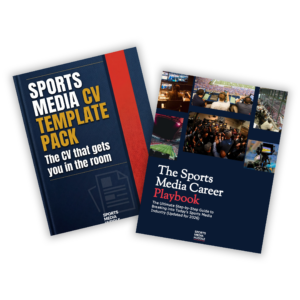
If you’re looking to turn these insights into a clear direction for your own career, The Sports Media Career Playbook breaks down the modern industry, the skills that matter most, and how to position yourself within today’s evolving media landscape.
Whether you’re just starting out or looking to refine your path, it’s designed to help you move forward with purpose and clarity.