How to Build a Sports Media Personal Brand in 2026
In a more competitive, more visible, and more digital industry than ever, your personal brand is your most powerful career asset – and the good news is that you can start building it today, regardless of where you are in your career

When I started out in sports media in the mid-2000s, the conversation around personal brand barely existed. You built a reputation through your work, through the relationships you forged in press boxes and production galleries, and through the quality of what you put out over time. Word travelled slowly and within small professional circles.
Social media existed, but it was not the professional tool it is today. It was primarily a place to share photos and connect with people you already knew. The idea that a platform could become the engine behind a career – capable of connecting you with editors, producers, hiring managers, collaborators, and audiences you had never met – was not yet part of how most people in this industry thought.
If I could go back and do it differently, one thing I would change above almost everything else is this: I would have invested in building my personal brand from day one, on the right platforms, in a consistent and intentional way. Not just for visibility’s sake, but because doing so would have accelerated almost every other part of the career – the relationships, the opportunities, the reputation, and the sense of professional identity.
This article is for anyone in sports media, whether you are just starting out or already a few years in, who wants to understand what a personal brand actually means in 2026, and how to build one that works for your specific role and ambitions.
What a Personal Brand Actually Means in Sports Media
Before we get into strategy, it is worth being precise about what a personal brand is, because the term gets thrown around a lot and is frequently misunderstood.
A personal brand is not your logo, your colour palette, or the font you use on your LinkedIn cover image. It is not the number of followers you have, and it is definitely not a fake version of yourself carefully curated for professional consumption.
The most useful definition I keep coming back to is this: your personal brand is what people say about you when you are not in the room. It is your reputation, your professional identity, the specific qualities and areas of expertise that others associate with your name.
The journalist who is known for breaking transfer news before anyone else. The producer whose live shows always run immaculately. The social media manager whose sports content consistently goes viral. The PR specialist who handles crisis communications with calm and precision. Those reputations are personal brands. They just may not be intentionally built ones.
The difference in 2026 is that you have extraordinary tools available to help you build that reputation deliberately, at a pace and scale that simply was not possible when I started out. And the stakes are higher than they have ever been. The most qualified person in the room rarely gets the opportunity. The most visible one does.
Recruiters search LinkedIn before reaching out. Decision-makers look up candidates before responding to emails. The industry has changed. The question is whether you are changing with it.
Why This Matters More Than It Ever Has
The numbers behind personal branding in 2026 are hard to ignore, and they apply directly to sports media careers.
Around 70% of employers say that a personal brand is more important than a resume or CV. In an industry where hundreds of qualified candidates apply for every good role, that is a striking reality check.
Approximately 74% of people are more likely to trust someone with an established personal brand. For sports media professionals – where credibility is your stock in trade, whether you are a journalist, broadcaster, producer, or communications specialist – that trust differential is enormous.
Professionals with active personal brands receive 47% more inbound opportunities than those with dormant profiles. That statistic alone should shift how you think about the time you invest in visibility.
And then there is the AI layer, which is genuinely new. AI tools like ChatGPT and Perplexity increasingly answer questions like “who is an expert in X?” by citing professionals with published, visible content. In other words, being found in AI-generated recommendations is now a real career advantage, and it only comes to those who have created a consistent body of public-facing work.
The barrier to entry in sports media has never been lower. Anyone with a microphone, a camera and an internet connection can publish sports content today. That is genuinely democratising in many ways, but it also means the competition is fiercer than at any point in the industry’s history.
A strong personal brand is one of the most effective ways to cut through that noise and be remembered by the people whose opinion matters most to your career.

The Single Biggest Shift: From Generalist to Specialist
This is the change I have thought about most when reflecting on how the industry has evolved since I started out.
In the mid-2000s, being a generalist in sports media had real advantages. You could stretch across multiple sports, cover different types of stories, and build a broad portfolio. The industry rewarded versatility. There were fewer voices, fewer outlets, and fewer ways for audiences to find specialist content, so breadth worked.
That is no longer the case. Going into 2026, standing out means being known for something specific, not trying to be good at everything. People are moving toward niche authority because it works. Personal brands built around a clear specialty or unique point of view get far higher engagement and trust.
The sports media landscape now contains an almost infinite amount of content. There are podcasts, newsletters, YouTube channels, social accounts, streaming shows, and websites covering every conceivable angle of every major sport and hundreds of minor ones. In that environment, the generalist gets lost. The specialist gets found.
Think about what this means practically. A sports journalist who covers everything gets noticed by no one in particular. A sports journalist who is known specifically for in-depth tactical analysis of European football, or for long-form profiles of women’s boxing, or for investigative reporting on the business of college athletics, that person becomes a go-to name in a specific conversation. They attract like-minded readers, collaborators, and commissioners. Their brand has gravity.
The same principle applies across every sports media role. A producer known for their expertise in live multi-camera sports broadcasts is more marketable than a producer who has done a bit of everything. A social media manager who has built a demonstrable track record in a specific sport or platform format will stand out against a generalist. A PR specialist who has carved a niche in crisis communications for professional athletes is more valuable than one who has done a bit of everything.
So before anything else, the first question to ask yourself is: what do I want to be known for? Be specific. Be honest about where your genuine expertise and passion intersect with a gap or need in the market. That answer becomes the foundation of everything else.

Step One: Define Your Brand Before You Start Building It
The temptation when you read articles about personal branding is to jump straight to the tactics. The posting schedule, the LinkedIn optimisation tips, the content pillars. Resist that. The tactics only work if they are built on a clear foundation.
Start by sitting with a few honest questions. What are you genuinely better at than most people you work alongside? What do colleagues and peers consistently come to you for? What aspect of your work excites you most, and where does your curiosity keep pulling you? What specific knowledge or perspective or access do you have that is not being expressed clearly enough in the public conversation?
You do not have to be the foremost expert on the subject to be seen as an expert. Nobody crowns you as a thought leader; you study the subject, share your thoughts, and talk about it enough that people begin to see you that way.
Once you have a sense of your specialist focus, you need to be able to articulate it clearly. What is the one sentence that captures your professional value? Not your job title, that is just a label. Your value proposition: the specific combination of expertise, perspective, and personality that makes your work and your voice distinctive.
For a sports journalist it might be: “I cover the business and politics behind elite sport, with a particular focus on how rights deals shape how fans consume live content.”
For a podcaster: “I specialise in in-depth interviews with youth boxers from the United Kingdom, providing a platform for up-and-coming fighters to share their stories while championing the next generation of boxing talent.”
For a social media manager: “I create short-form sports content that consistently breaks audience records, with a specialism in women’s basketball.” Each of those is a brand statement, not just a job description.

Step Two: Build Your Digital Foundation
Once you know what you stand for, you need to build the infrastructure to express it consistently online. This does not require an elaborate website or a production budget, it requires clarity and consistency.
Your LinkedIn profile is your most important professional asset. LinkedIn has surpassed 1.2 billion users globally, and the platform is projected to exceed 1.3 billion in 2026. Video content uploads grew by 20% year-over-year, with views increasing by 36%. The platform is no longer just a digital CV. It is the primary space where professional credibility is built, signalled, and discovered.
Treat your LinkedIn headline as your value proposition in one line, not just your job title, but what you do and for whom. Your About section should tell a story: your journey, your specialist focus, your driving curiosity in the field. The Featured section should contain your best work – published articles, broadcast clips, campaigns you led, or projects you are proud of. Recommendations from people who have worked with you carry significant weight. Skills endorsements that map directly to your specialism are worth cultivating.
Beyond LinkedIn, choose your platforms based on your role and your audience, not because someone told you to be everywhere. If you are a journalist or analyst, X (formerly Twitter) remains one of the most important platforms in sports media for breaking news, industry conversation, and building connections with peers.
Instagram and TikTok are increasingly important for production and content roles, where visual storytelling is part of your skillset. YouTube suits broadcast journalists, analysts, and podcasters who can build episodic content around their specialism. The key principle is: do fewer platforms well, rather than spreading yourself thin across all of them.
Your email or bio consistency matters too. The same headshot, the same professional description, the same link to your best work should appear wherever your name is publicly visible.

Step Three: Create Visible Proof, Not Just Claims
The most important thing a personal brand does is demonstrate expertise rather than simply assert it. Saying you are an expert in something is easy. Proving it through a consistent body of public work is what actually builds reputation and trust.
True thought leadership in 2026 is sharing original, experience-based insights that change how others think or behave. This differs fundamentally from curating other people’s content or echoing industry consensus. It establishes authority that transcends a traditional resume.
What this looks like in practice varies by role:
For journalists and reporters, it means publishing regularly, whether through your employer, a personal newsletter, or a byline with a publication that covers your niche. It means having opinions and being willing to share them. It means making your analytical process visible: showing readers not just what happened, but how you think about what it means.
For broadcasters and on-air talent, it means creating short-form content that demonstrates your voice and presenting style beyond the clips your employer has produced. Behind-the-scenes commentary, short video analysis pieces, or even audio reactions shared on social media all serve as portable portfolio items that exist independently of any one employer.
For producers and technical directors, it means documenting your work in ways that can be shown publicly. Case studies on LinkedIn about productions you led, articles about technical challenges you solved, or participation in industry conversations about production innovation. All of these build a visible record of expertise.
For social media managers and content creators, visible proof is the easiest to build and the easiest to measure. The content you create, the campaigns you run, and the results you generate are inherently public. Sharing what worked and why – on LinkedIn or through a newsletter – demonstrates not just creativity but the strategic thinking behind it.
For PR and communications specialists, it might be opinion pieces about how sports organisations should be communicating on a particular issue, case study breakdowns of PR campaigns (appropriately anonymised), or LinkedIn posts that share frameworks and approaches you use in your work.
For data journalists and analysts, it is publishing your analysis publicly – through a Substack, a personal site, or platforms like Medium – and contributing to the growing community of people using data to tell sports stories.
The single most important principle across all of this is: consistency over volume. One thoughtful piece of content per week, published reliably over a year, does more for your brand than a burst of activity followed by silence.
Only 1% of LinkedIn users post content weekly, yet that group generates 9 billion impressions per week. Simply showing up regularly puts you in a visible minority.

Step Four: Engage, Don’t Just Broadcast
One of the most common mistakes people make when building a personal brand is treating it as a broadcast operation by posting content and waiting for an audience to arrive. That is not how reputation is built in sports media, and it is not how it is built online either.
Commenting on industry posts is significantly more effective for driving profile visits than relying solely on original content creation. When you leave a thoughtful, insightful comment on a trending post, your name, your headline, and your ideas are broadcast to everyone who views that post.
Engage meaningfully with the work of people you respect in the industry. Add something to the conversation – a different perspective, a piece of context, a question that takes the discussion somewhere useful. Do not leave generic comments. The person who consistently adds value to the conversations happening in their specialism builds recognition far faster than the person who only publishes their own content.
This is also how relationships form in a remote and distributed industry. Some of the most valuable professional connections I know of in sports media started with a reply on social media that sparked a real conversation. Do not underestimate the career value of being genuinely present and generous in the professional community of your specialism.

Step Five: Your Brand is Portable. Protect It
This is perhaps the most strategically important element for sports media professionals specifically, and it is one that the industry has not always thought about clearly.
Your employer’s brand is not your brand. They are related, but they are not the same thing. The Nieman Reports piece on journalism and personal branding articulated this clearly: building a visible personal brand provides leverage independent of any institution, and shows that a journalist or media professional has a quantifiable reach that exists regardless of where they are employed.
The sports media industry is volatile. Outlets close, formats change, roles are restructured. Redundancy in media is not an edge case, it is a regular occurrence. The journalists and media professionals who bounce back fastest from job losses are almost always those who have maintained a personal brand that exists independently of any single employer. Their audience, their reputation, and their network travel with them.
This does not mean you should be posting content that undermines or contradicts your employer. It means you should be consistently investing in a professional presence that is yours – your byline, your newsletter, your social following, your reputation in your niche – so that if and when you need or want to move, you have something substantial to take with you.
One practical note here: if you host a podcast or newsletter as part of your brand, own the RSS feed and the subscriber list. That is your asset. Do not let it sit entirely within a platform or employer ecosystem you do not control.

Step Six: Show Up in the Room, Not Just Online
Everything covered in the previous five steps is genuinely important. But there is a dimension of personal brand that no amount of LinkedIn activity, newsletter subscribers, or social media followers can substitute for. And it is the one that was the foundation of professional reputation long before social media existed.
It is how you actually do the work.
The most powerful personal brand in sports media is built on a simple compound: what people say about you online, and what people say about you when you walk out of the room. Both matter. And in sports media specifically – an industry built on deadlines, live moments, and high-pressure collaboration – the offline reputation is often the one that opens doors.
Think about what that reputation actually consists of in practice. It is whether you file clean copy on deadline, every time, without having to be chased. It is whether you arrive to a production gallery or a press conference having done the preparation. It is whether you deliver what you promised to a colleague, a manager, or a client without excuses. It is how you respond when something goes wrong on a live broadcast or during a breaking news situation, whether you panic, or whether you are steady and solutions-focused. It is whether other people genuinely enjoy working with you and seek you out for future projects, or whether they quietly hope you end up on someone else’s team.
These things are your brand. They always have been. The difference now is that digital visibility has added a new layer, not replaced the foundation.
I have seen careers stall despite impressive online profiles because the lived experience of working with that person did not match the projection. And I have seen careers accelerate significantly for people who had virtually no digital presence at all, simply because everyone who had ever worked with them spoke about them the same way: reliable, excellent, calm under pressure, and generous with their time and knowledge.
The insight here is not that online brand-building is overrated. It is that it has to be built on something real. Authenticity is one of the most frequently cited qualities of effective personal brands. And authenticity, in the professional context, means that what you claim and what you deliver are consistent. If you position yourself as a specialist in live production excellence on LinkedIn but the crews you work with know you as someone who cuts corners or is difficult to manage in high-pressure moments, the disconnect will surface eventually.
There are a few specific qualities that colleagues, editors, and hiring managers in sports media consistently identify as reputation-defining. Being reliable (doing what you say you will do, when you said you would do it, to the standard expected) is perhaps the most powerful professional quality there is, and also one of the rarest.
Being collaborative rather than territorial, particularly in production and broadcast environments where every role depends on every other role performing well. Being curious enough to keep learning, especially as the tools, platforms, and formats of sports media continue to shift. Being the person who brings solutions to problems rather than just identifying them.
None of those things live on social media. But all of them feed directly into the reputation that travels, through word of mouth, through references, through the organic way that opportunities move toward certain people in an industry and away from others.
The practical implication is straightforward: treat every piece of work as a contribution to your brand, not just the content you publish publicly. The segment you produce for an audience of 200,000 people and the email you write to a colleague at 11pm before a deadline are both expressions of your professional identity. The care and thoughtfulness you bring to each shapes what people say about you when you are not there.
Online brand-building amplifies what already exists. If the foundation is strong, if you genuinely are the person your professional presence suggests, then visibility accelerates everything. If it is not, no amount of posting will paper over the gap for long.

Platform Priorities: A Role-by-Role Guide
Different roles in sports media naturally suit different platforms. Here is a practical guide to where to focus your energy, depending on your specialism.
Sports reporters and beat writers should be most active on X, where sports news breaks and where journalists build source networks and readership. LinkedIn matters for career reputation and industry connections. A newsletter through Substack, Beehiiv, or a similar platform is increasingly valuable as a direct relationship with readers that no algorithm can disrupt.
Broadcasters, play-by-play announcers, and on-air talent should prioritise YouTube and Instagram for short-form demo content. LinkedIn matters for industry reputation. Building an audience that follows you as a voice, not just as an employee of a particular network, is the goal.
Broadcast producers and technical directors are often the least visible members of a media team, which means there is significant white space to fill. LinkedIn is the primary platform. Publishing case studies, sharing production knowledge, and participating in industry communities like forums or LinkedIn groups builds a professional reputation that most competitors are not investing in.
Social media managers and content creators live on the platforms they manage, but the professional reputation layer should also be on LinkedIn, where you can show the strategy behind the content, not just the content itself. Writing about your process, your results, and your thinking separates you from the many people who can operate a scheduling tool.
PR and communications specialists benefit most from LinkedIn and, where relevant, from writing for industry publications. The specialism of a PR professional is in narrative and communication, and demonstrating that through your own well-crafted professional presence is itself a proof point.
Data journalists and analysts have an excellent opportunity on LinkedIn and through personal publication platforms (Substack, Medium, a personal site). The sports analytics community is engaged and growing. Publishing work publicly, even at a small scale, builds recognition in a specialism where genuine expertise is scarce.
Podcasters and audio content creators should treat every episode as a brand asset; optimised with good titles, consistently promoted across platforms, and building toward a body of work that stands on its own. YouTube is increasingly the primary discovery platform for podcast content, so a video presence matters even if audio is your primary format.

Consistency is the Strategy
I want to return to something I mentioned earlier, because it is the part that trips people up most often: consistency.
Building a personal brand in sports media is not a campaign with a start and end date. It is an ongoing practice, like staying fit or keeping up with your field. The people who build the most powerful reputations in this industry are not the ones who post the most content, or who have the cleverest strategy, or who spend money on professional photography and well-designed profile headers. They are the people who show up, reliably and generously, in their specific corner of the industry, over months and years.
Building a personal brand is an ongoing process. You may start seeing results within a few months, but consistency and adaptability are key to long-term success.
The practical implication is to build a routine you can actually sustain. One LinkedIn post per week. One newsletter per fortnight. A short video reaction once a week. Thoughtful comments on three or four relevant posts each day. Whatever the format, the commitment has to be realistic enough that you can maintain it through busy periods, not just when it feels easy.
If you are at the early stages of your career and feel like you do not have enough expertise or experience to produce valuable content, I would push back on that. You have a perspective that is genuinely useful: the view from the start of a career, the questions you are trying to answer, the things you are learning as you go.
Documenting that journey authentically has real value for the large community of people who are at a similar stage. You do not need to be an expert to be worth reading, you need to be genuine, curious, and consistent.

Common Mistakes to Avoid
A few patterns come up repeatedly in how people approach personal branding in sports media, and they are worth naming directly.
Being inconsistent across platforms. If your LinkedIn profile says you are a sports journalist specialising in women’s football, but your X bio says you love Taylor Swift, and your (public) Instagram contains no professional content at all, you are sending mixed signals. Alignment across platforms is not complicated, but it matters.
Waiting until you need it. Personal brand building is not something you should start when you are job-hunting or facing redundancy. By that point, you are building under pressure and without the time needed to develop something credible. Start now, build slowly, and the asset will be there when you need it most.
Copying what everyone else is doing. The sports media world on LinkedIn, in particular, has developed some lazy content habits; hot takes on the latest news, listicles of career advice, reposted articles with a one-line opinion attached. If that is all your feed is, it is not a brand; it is background noise. Do the harder work of producing something original, specific, and genuinely useful.
Talking only about yourself. A personal brand that is entirely self-promotional quickly exhausts its audience. The most effective professional brands are generous. They share knowledge, spotlight others, celebrate good work in the field, and add value to the community before asking anything in return.
Ignoring the offline dimension. Your personal brand is not only digital. Industry events, conferences, press trips, and informal professional gatherings are still where significant relationships form in sports media. The in-person version of your brand – how you engage, how curious you are, how collaborative you come across – should be consistent with what you project online.
The Longer View
When I think about where the sports media industry is heading, with the continued growth of streaming, the creator economy reshaping what distribution looks like, the declining barriers to independent publishing, the increasing importance of niche audiences over mass reach, the case for building a strong personal brand only gets stronger.
The sports media professionals who will thrive over the next decade will not necessarily be the ones who got into the best outlets or landed at the biggest networks at the start of their careers. They will be the ones who built something that is genuinely theirs: a reputation, a specific expertise, a community of engaged followers, a portfolio of work that exists independently of any platform or employer.
The tools available to build that are better than they have ever been. The audiences are more reachable. The niche communities are more accessible. The only thing standing between where you are now and a genuinely strong professional presence in your specialism is the decision to start. And then to keep going.
Start small. Start specific. Start today.
Ready to take the next step?
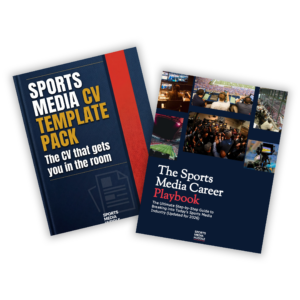
If you’re looking to turn these insights into a clear direction for your own career, The Sports Media Career Playbook breaks down the modern industry, the skills that matter most, and how to position yourself within today’s evolving media landscape.
Whether you’re just starting out or looking to refine your path, it’s designed to help you move forward with purpose and clarity.