How to Create a Sports Media CV That Actually Gets You Interviews
A hiring manager spends an average of 30 seconds on an initial CV review. In that window, they decide whether your document is worth their time. Most CVs don’t make it. Here is how to build one that does — specifically for sports media roles.

Let’s start with the uncomfortable truth. According to ResumeGo’s 2024 survey of 418 hiring professionals, 81% of recruiters spend less than a minute on a CV during initial screening.
Research from InterviewPal’s 2025 data study — tracking 4,289 anonymised resume reviews across 312 recruiters — found that the average initial scan time is just 11.2 seconds.
In those seconds, a hiring manager is not reading your CV. They are scanning it for signals: is this person in the right world, do they have relevant experience, does this document look like it was written for this role or for every role?
Most CVs fail before they are read. Poor structure, generic language, buried experience, and a complete absence of anything specific to the sports media industry. These are the decisions that cost people interviews before the quality of their work ever comes into question.
The sports media CV has specific requirements that generic career advice does not cover. This guide addresses them directly.
The Fundamental Principle: Lead With What Matters Most
The most important structural decision you will make on your sports media CV is where to put your sports media experience.
The instinct is to order your career history chronologically; most recent first, everything else following in descending order of date. This is the wrong approach for sports media applications if your most recent experience is not your most relevant experience.
A hiring manager at a broadcaster, a club, a sports agency, or a media organisation is looking for one thing before anything else: evidence that you are already in this world.
They care less about what your most recent job title was than about what you have done in the industry, however that happened; paid work, voluntary roles, freelance credits, shadowing, personal projects, or any combination of the above.
Sports media experience leads. Always. Even if it is three months of voluntary matchday support, one published article, or a podcast you have been running independently. That goes at the top of your experience section, above whatever else you have done professionally.
Your career history outside sport follows it. A hiring manager will read the first section of your experience with attention and the second with context. Give them the right first impression.

Section by Section: How to Build the CV
Your Name and Target Role Title
Your name exactly as it appears on your professional profiles. Beneath it, a target role title; not a generic self-description, but a specific reflection of the role you are applying for.
If the job is Digital Content Producer, your CV says Digital Content Producer. If the job is Broadcast Production Coordinator, your CV says Broadcast Production Coordinator. This single change immediately signals to the hiring manager that this document was written for them. Generic CVs feel generic from the first line.
Professional Summary
Three to four sentences. This is the section most worth tailoring and the one most candidates get wrong.
Open with your professional identity; who you are and what you do. Follow with your most relevant skills and the specific value you bring. Close with your career direction. The summary should speak directly to the role and the organisation.
A summary that says: “I am passionate about sports media and eager to contribute to a dynamic team” appears on every CV submitted to every sports organisation. It tells a hiring manager nothing.
A summary that says: “Sports journalist with three years of independent newsletter and podcast experience covering women’s football, specialising in data-led analysis and community storytelling, now seeking a staff role in digital editorial at the club or federation level” tells a hiring manager exactly who you are, what you do, and what you are looking for. The specificity is the point.
If you are transitioning from a different industry, your summary is where you frame the transition explicitly. Something like: “Communications professional with five years of live operational experience in broadcasting logistics, currently building industry credits through voluntary matchday broadcast support at X, seeking a full-time role in sports production coordination.”
This tells the story before the hiring manager has to piece it together.
Sports Media Experience: The Top Section
This section appears before your other professional experience deliberately. List every sports media credit here — broadcast work, published pieces, event coverage, content creation, podcast production, PR and communications work in sport, photography at live events, data analysis published publicly.
Name the system, the publication, the broadcaster, the platform, the event. Be specific.
“Worked in sports journalism” tells a hiring manager nothing.
“Produced and published a weekly newsletter covering Scottish Premiership analytics, growing to 3,400 subscribers in 18 months with a 42% open rate, featuring original data visualisations and exclusive club interviews” tells them a great deal.
The difference is specificity and evidence. Every bullet point in this section should do the same work: strong opening verb, specific context, quantified result or scale where possible.

Lead every bullet with an action verb
Replace weak verbs like “helped,” “assisted,” or “was responsible for” with confident, specific language. A journalist does not “help with articles”, they report, write, pitch, investigate, source, break, cover, profile.
A producer does not “assist with production”, they coordinate, direct, deliver, schedule, operate, transmit. The verb is the first word a hiring manager reads in each bullet. Make it count.
Include a portfolio link wherever your work has been published or produced. In sports media, showing is always more powerful than telling. If you have published work, broadcast credits, or a content portfolio, link directly to it. JournoPortfolio, a personal website, a YouTube channel link, a Substack — whatever holds your best work, reference it clearly.
Other Professional Experience
Your career history outside sports media goes here, but the language needs to work for sports media applications.
Every role carries transferable skills. Most live operational roles translate directly to broadcast production. Managing events under deadline pressure is directly relevant to gallery operations. Leading cross-functional teams is directly relevant to production coordination.
Running marketing campaigns is directly relevant to content strategy and social media management. You do not need a sports job title to demonstrate sports media relevant skills. You need to translate the language.
Reframe your responsibilities and achievements using terminology that is relevant to the industry: live environments, deadline pressure, stakeholder management, content production, audience development. Lead every bullet with a strong action verb. Quantify wherever possible; team sizes, budgets managed, percentage improvements, audience numbers, events delivered.
What you do not do is hide this section or apologise for it. Your previous career history is not a weakness on a sports media CV. It is a source of transferable skills that many traditionally trained candidates in the industry do not have. Frame it that way.
Core Skills
Your skills section is a targeting mechanism. It exists to match your profile to the language of the job description, and specifically, to survive the Applicant Tracking System (ATS) screening that filters CVs before a human ever reads them.
According to Insight Global’s 2025 AI in Hiring Report, 99% of hiring managers now use AI in some part of the recruitment process. The majority of applications to medium and large organisations, including major broadcasters, clubs, agencies, and federations, are screened by ATS before reaching a recruiter.
If your CV does not contain the keywords from the job description, it may be automatically filtered out. Research from Forbes finds that the average CV lists only about half of the keywords used in the job description it is being submitted for.
Read the job description carefully before you finalise your skills section. Mirror the exact language they use. If the description says “social media management,” your CV says social media management, not “digital content.” If they list “live event production,” you list live event production.
Do not list every skill you have ever developed. List the 10-12 most directly relevant to this specific role. A skills section that lists twenty items prioritises none of them.
The skills section should reflect the role you are applying for. A sports journalist and a broadcast producer have different skill sets. A social media manager and a PR professional need different things front and centre. Review and adapt for every application.
Education
Degree title, institution, and dates. If you have a journalism, media, communications, or sports management qualification, lead with it. If your degree is in something unrelated, include it but do not make it the prominent element of your CV — let your experience do that work.
Include relevant short courses, professional qualifications, and certifications here too: ScreenSkills, journalism training, broadcast qualifications, digital analytics certifications.
Languages, Tools, and Interests
Languages with honest proficiency levels. Tools and platforms you can actually use; Adobe Premiere Pro, Descript, Riverside, Canva, WordPress, beehiiv, whatever is relevant to your target role. Do not list tools you have only encountered briefly or cannot demonstrate in a professional context.
Interests: keep them specific and relevant to the industry. The sport you cover, play, or follow with genuine depth signals to a hiring manager that you are already in the world they are hiring for. Generic interests — travelling, socialising, cooking — add nothing to a sports media CV and waste space.

The Tailoring Principle
The biggest mistake candidates make is sending the same CV to every application. A strong CV is not a generic document, it is a tailored argument for why you are the right person for one specific role.
These are the four things to change for every application, and only these four need to change:
Target role title
Adapt it to match or closely mirror the exact title of the role. Ten seconds per application.
Professional summary
Rewrite the first sentence to name the type of organisation you are applying to and the specific value you bring it. Reference something specific about the role or organisation if you can. Three tailored sentences beat four generic ones every time.
Core skills
Match your skills list to the language of the job description. Mirror their terminology exactly.
Bullet point emphasis
Within your experience sections, move the most relevant bullet points to the top of each role. If you are applying for a social media role, social media responsibilities lead. If you are applying for a journalism role, your writing credits come first.

The Most Common Mistakes on Sports Media CVs
These are the decisions that cost candidates interviews before the quality of their work is ever assessed.
Sending the same CV to every role
The most common and most costly mistake. A generic CV tells a hiring manager you did not take the application seriously enough to tailor it for them.
Burying sports media experience beneath years of unrelated history
The hiring manager at a sports broadcaster is not looking for your most recent job. They are looking for evidence you are already in this industry. Put that evidence first.
Listing responsibilities instead of achievements
“Responsible for social media” tells a hiring manager nothing. “Grew Instagram following by 40% in six months, reaching 12,000 followers, through a daily match reaction video series” tells them everything. The responsibility is expected. The achievement is evidence.
Vague language
“Passionate about sports media” and “excellent communication skills” appear on every CV submitted to every sports organisation. These phrases are so common they have lost all meaning. Specific credits, specific outcomes, and specific skills are what differentiate one candidate from another.
No portfolio link
In sports media, showing is always more powerful than telling. If you have published articles, broadcast work, a YouTube channel, a podcast, a newsletter, or a photography portfolio, link to it. A hiring manager who can click through to your work in 30 seconds has more evidence of your capability than your CV alone can provide.
Skills section that lists everything
Twenty skills listed equally prioritises none of them. A hiring manager scanning for relevance needs to be able to identify your core competency area in a second. Fifteen to twenty items in a skills section suggests you have not thought carefully about what matters most for this role.
Generic interests
“Travelling and socialising” adds nothing. The podcast you produce, the outlet you write for, the sport you play or cover at any level — these tell a hiring manager you are already living in the world they are hiring for.
Not naming specific publications, systems, events, or broadcasters
“Worked in sports journalism” is not a credit. “Covered live matchday reporting including pre-match previews and post-match athlete interviews for Sportsmail, with eight pieces published in the 2024-25 season” is a credit. The specificity is the evidence.
Typos and grammar errors
Research from The Motley Fool finds that nearly 80% of recruiters will reject a CV because of typos or grammatical mistakes. Proofread. Then proofread again. Then ask someone else to proofread it.

Building the Credits Before You Apply
The most effective thing you can do before submitting a sports media CV is to add something to the sports media experience section.
One voluntary matchday role. One freelance piece published somewhere. One event you have shadowed at. One podcast episode published. One newsletter issue sent. Any of these changes the entire tone of your CV from “aspiring” to “already doing it.”
The aspiring candidate and the candidate who is already doing it at any level are not in the same category for a hiring manager. One of them has evidence. The other has intent.
If your sports media experience section is currently empty, filling it — even with one small credit — is more valuable than any other improvement you can make to your CV.
The Sports Media Career Playbook exists precisely to help you build those first credits quickly and deliberately. The CV is the door. What you have done is what opens it.

One Final Thing
The best version of this CV is the one that gets you in the room. Once you are there, it is your story, your passion, and your knowledge of the industry that closes the deal.
The CV is the argument that earns you the conversation. Make it specific, make it honest, make it tailored, and make sure everything on it is evidence you can speak to confidently when the hiring manager asks about it.
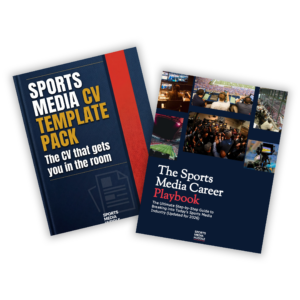
The Sports Media Huddle CV Template Pack includes the sports media CV template, the section-by-section completion guide, and the role-specific action verb sheet. It’s available here:
Ready to build your CV?
The Sports Media CV Template Pack gives you everything you need to present yourself professionally; a purpose-built CV template designed specifically for sports media roles, a section-by-section completion guide, and a full action verb sheet structured by role type.
Whether you’re applying for your first industry role or making the move from a different career, it’s built to help you walk into every application with confidence.